




Linux Aquarium PC

4 min read18.11.2021
Carl Jung once said, “The creative mind plays with the object it loves.” Like Jung, we believe play can fuel innovation, and sometimes, the wilder the idea, the better. 🎨
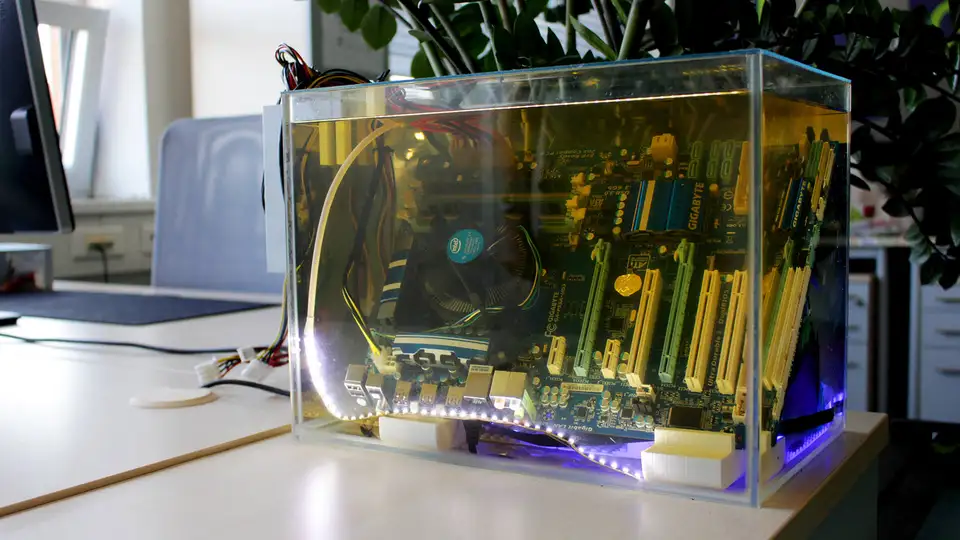
You might be wondering why would we submerge a PC in liquid (in our case, mineral oil)? To that, we reply, “Why does anyone climb Mount Everest? Because they can.” So, we did! We created a Linux PC from upcycled computer parts, submerged it in mineral oil, lit it with LED light strips, and added a LEGO ship, because no aquarium is complete without a sunken ship. Best of all, we did it together.
Construction
We took old computer parts, including a motherboard, CPU, RAM modules, a hard drive, power supply modules, and hard disks from older notebooks. While not needed to run the PC, we used an older GPU during setup. We bought 15 litres of shell tellus s2 mx 46 mineral oil from a farmer friend for a good price. CAUTION: Don’t try this without the aid of computer and oil experts. ⚠️
At 220 volts, the power supply is on the side of the tank, supported by two L-shaped parts we 3-D printed. IO ports at the bottom of the tank support the motherboard, and create space for the LAN cable. The system temperature before submersion was about 70 C under load. Submerged, it peaked at 40 C and remains stable.
Issues during and after the test drive
One small but significant oversight led to some very funny and chaotic results…we forgot to cover the tank! As a result, two large flies are now permanent residents at the bottom. This would be even more hilarious if they were in old-school diver suits, hovering around a sunken treasure chest. The chaotic part happened when the CPU fan hit the surface of the oil, and sprayed us all. We all panicked—some of us ran for cover and others improvised a cover to contain the mess.
Conclusion
Was this fun? Did we learn something? Was it worth it? Yes to all. Is this a viable option for cooling a computer? Well, it depends. The temperature is low even under load, but there are drawbacks, like really greasy servicing if something goes bad. And, oil is expensive. We knew this beforehand. We did this mainly for fun; it’s really entertaining to watch the CPU fan rotating slowly in the liquid.
The Linux aquarium PC is now a permanent fixture in our Ostrava office. We also use it for “underwater software testing”; when we use it to run a GitLab CI/CD agent. See for yourself HERE.